
Get the book!
 “We’re excited that The ‘Perfect’ Parent is joining this year’s list of award-winning products,” says Julie Kertes, NAPPA General Manager.
The Book »
TOG Newsletter
Search This Site
The Tools
Testimonials
Recent Posts
Archives
Close Enough to Kiss: The Power of Touch
Posted on April 25, 2014
This week’s post is written by TOG team member and mom, Elizabeth Y., whom you’ve previously met in our post about routines. You’re on, Elizabeth
Thanks so much for the introduction and opportunity Roma!
After the birth of my second baby, I worried about how I would keep up with an active 2 1/2 year old. I came across babywearing. And two years later…I’m still babywearing (toddler wearing now) with no plans to stop.
But why has babywearing become so important to me? Is it just the convenience? Well, the convenience is certainly great. It’s much easier to hold my older daughter’s hand in a busy parking lot without having to carry a heavy infant car seat. But babywearing offers scientifically shown developmental and emotional benefits too. Babywearing has helped me be a sensible (or sense-able parent, as Roma would call it). It has given sensory reassurance to my daughter. We see, hear, smell, and feel each other constantly. We are more in touch.
And touch is an incredibly useful tool of growth, as shown by the use of skin to skin therapy (or kangaroo care) in Neonatal Intensive Care Units. These vulnerable babies gain weight faster, better regulate their temperature and breathing, and even sleep better all because of the power of touch. Dr. Dacher Keltner, PhD, the faculty director of the Greater Good Science Center at UC Berkeley, writes “Touch is the real action of compassion. It is an unbelievable mechanism of social well being and it [touch] may very well be the greatest.”
So babywearing has helped me be more in touch with my child. Its safety guidelines, an acronym called T.I.C.K.S., can even provide a framework for sensible (and sense-able!) parenting:
T: Tight (The carrier should be tight around the wearer and baby.) — All families should be tight, right? We wrap our support tightly around each other to create a sense of security and safety.
I: In view at all times (The baby’s face should be in view and clear of fabric.) — When children are younger, we keep a literal eye on them. As children become older and more independent, it becomes more of a figurative eye. We need to know if our children are okay, physically and emotionally, even if we can’t see them.
C: Close enough to kiss (You should be able to kiss the baby’s head by simply looking down) — We all want our kids to be close enough (again, literally and figuratively) to express our love for them.
K: Keep chin off chest (There should always be at least a finger width of space between the baby’s chin and chest.) — In our love for our children, we must allow them room to breathe. They need the space to become their own person. This is how we can honor their uniqueness.
S: Supported back (The carrier should support the baby’s back in its natural, not slumped position) –This can be interpreted two ways: 1) we need to support our children in a way that develops their own strength and backbone (maybe we need to back our children to build their own core strength ) and 2) we always have our children’s backs. We are their support system as they develop their own internal support system.
Babywearing and the accompanying power of touch has made it easier for me to be a sensible AND sense-able parent. I am literally in touch with my child as she sleeps on me–I feel her breathe and move around as she dreams and I am there as she wakes up calmly. Whether or not babywearing is right for your family, sense-able parenting is something we can all benefit from. For more on sensible parenting, watch for our upcoming book, “The “Perfect” Parent” and connect with us on Facebook and Twitter!
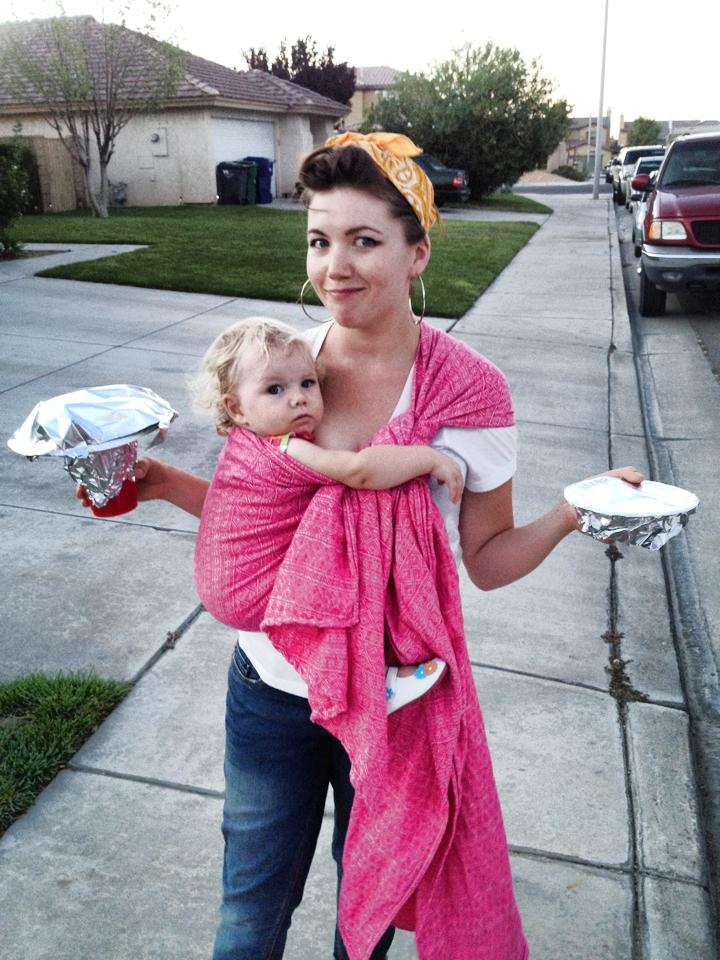
Two free hands and a cuddly baby.