
Get the book!
 “We’re excited that The ‘Perfect’ Parent is joining this year’s list of award-winning products,” says Julie Kertes, NAPPA General Manager.
The Book »
TOG Newsletter
Search This Site
The Tools
Testimonials
Recent Posts
Archives
How Can Parents Help Kids Help Themselves?
Posted on June 1, 2012
~The highest form of study or knowledge is not found in books, it is found in oneself.~
The best time for children to learn about themselves is when they make mistakes. I particularly remember one instance when my 7-year-old daughter Nitasha pushed my 4 year old son Navin in order to get to the front door first when Dad came home one evening. In the race, Navin fell, hit his mouth on the ground and had a small cut on his lip. Navin was screaming and seconds later so was Nitasha. He was screaming from the pain and she from seeing the blood on his lip. My husband got to Navin first and took him to the kitchen to get some ice for his lip. In the mean time, I held Nitasha because I knew she didn’t mean to do it and was scared.
However, Nitasha thought since she had Mom’s love and attention, Mom must not be mad at her. She immediately said, “I didn’t mean to. It’s his fault; he was in my way! I almost fell too because of him.” AHA! My smart big 7-year-old thought she could push the blame on her brother. An act of self defense that we learn very early. The blame game! Once everyone was calm and settled and dinner was done (Nitasha didn’t eat much and was still very quiet), I took Nitasha to her room and said, “I know you didn’t mean to hurt your brother and I know it hurt you to see him hurt, but I really want you to think about why you pushed him. I know you’re a smart girl and you can figure out why. Think about it for a few minutes, I have to use the rest room. I’ll be right back and then we can talk about your answer.”
Giving her those few quiet moments of self-reflection was paramount. I really didn’t need to go to the bathroom, but I truly believe the faster you can get your child to self reflect with their guard down and emotions under control, the quicker the shift to self-realization. Self-reflection and realization ALWAYS lead to growth. The type of growth our children do not get from books.
When I returned, I sat close to Nitasha and held her hand so that she could keep her guard down and respond calmly (I know keeping emotions out of the fear zone allows us to think clearly!). In a kind tone of voice I asked her what her answer was. As expected, my competitive Nitasha started crying and said, “I wanted to get to the door first.” That was all I really needed. I had practiced sensible parenting and had opened the door to communicate with her and it worked! I then helped her walk through her own very first feeling of “wanting to be first” all the way to how she felt when she saw her brother’s lip bleeding. I explained how being “first” really does not feel better than the sadness she felt when she saw the bleeding lip. She agreed and said, “That’s why I started crying. I was scared that I did that. I didn’t mean to. I should come first only if it feels good!” and she started crying again… BINGO, she figured it out on her own!
Something shifted in Nitasha that day. She is still competitive but has never hurt anyone along the way. In fact, she is competitive and never even gloats about her victories to others. I think that day, by her own little 8-year-old Self, she sowed the seeds of competing with her self — doing better than she did the last time — all the while hurting no one and staying in the Feel Good Zone.
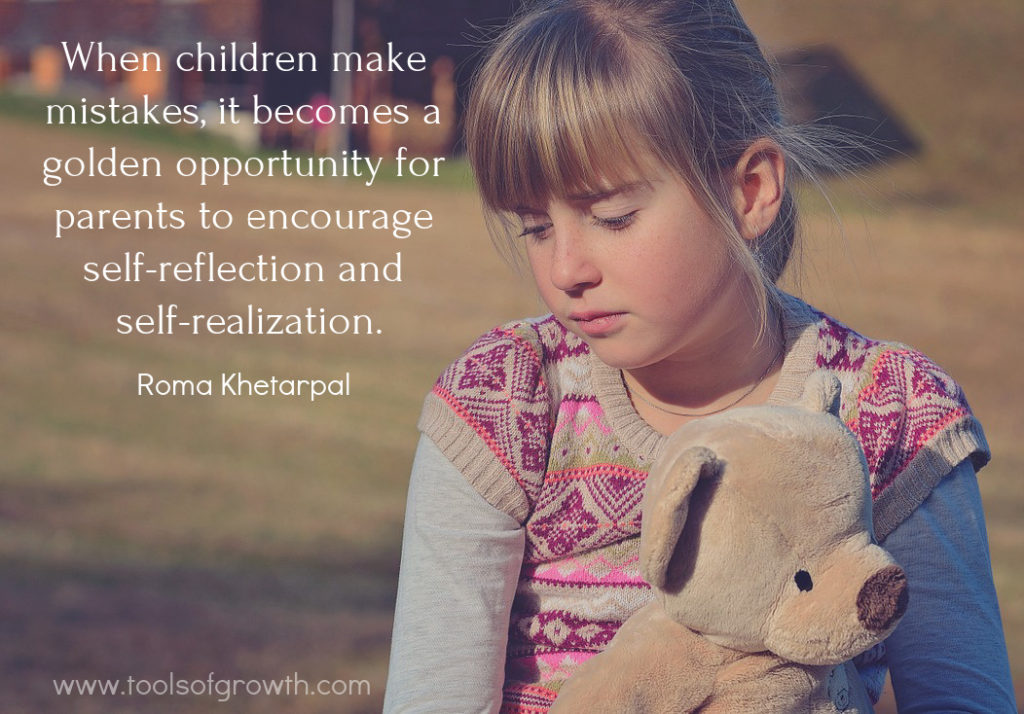
When children make mistakes, it becomes a golden opportunity for parents to encourage self-reflection and self-realization. The knowledge that children gain and the conclusions they form from that are opportunities for tremendous growth and can only be gained by going inwards! This personal growth then translates into other areas of one’s life like being emotionally intelligent, having strong social skills and stellar leadership skills.
I didn’t know this back then, but today, research indicates that self-reflection builds leadership skills.
No wonder, then, that Nitasha is a strong leader and a true inspiration at the young age of 24. All I did as a parent was try my best to activate my PGS (Parental Guidance System) by keeping my emotions and responses in check giving her space to think for herself, keeping in mind her best interest… it really was not hard. It took a little practice and self-reflection on my part, as well. But the more I practiced, the better I got. Practice might not always make you perfect, but it can get you pretty close! In hindsight… the results …PRICELESS.
Tweet